But the report also acknowledged that "the breakup of the crew module ... was not survivable by any currently existing capability."
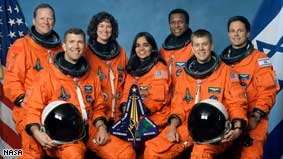
The NASA report found the astronauts knew for about 40 seconds that they did not have control of the shuttle before they likely were knocked unconscious as Columbia broke apart around them.
The report also found that while crew members were wearing their pressurized suits, one astronaut did not have on a helmet, three were not wearing gloves and none lowered the visors before the module lost cabin pressure. One astronaut also was not seated.
"In this accident, none of those actions would have ultimately made any difference," said former shuttle program manager Wayne Hale, now a deputy NASA administrator.
The graphic, 400-page investigative report relied on video, recovered debris and medical findings, supplemented with computer modeling and analyses. It also includes many recommendations to make space travel safer for future astronauts.
A shuttle-program source told CNN the families of the astronauts who died were brought in specifically to look at the report and even in some cases to help with its preparation. The report took more than five years to complete.
"The members of this team have done an outstanding job under difficult and personal circumstances," said Johnson Space Center director Michael L. Coats. "Their work will ensure that the legacy of Columbia and her heroic crew continues to be the improved safety of future human spaceflights worldwide."
Columbia broke apart some 200,000 feet over Texas -- just minutes before it was to have touched down in Florida. The shuttle's wing was damaged on takeoff when a large piece of heat-reflecting foam ripped off and gouged a hole in it.
During re-entry, the hole allowed atmospheric gases to burn the wing and destroy the spacecraft. The oldest orbiter in the fleet, Columbia had just completed a 16-day science mission.
Killed were commander Rick Husband, pilot Willie McCool, payload commander Michael Anderson and mission specialists David Brown, Kalpana Chawla, Laurel Clark and Ilan Ramon, an Israeli Air Force colonel who was Israel's first astronaut.

Niciun comentariu:
Trimiteți un comentariu